“We all live off that intellectual record. So what we want to do is get as much into the record, prevent as much as possible being deleted from the record, and then make the record as searchable as possible.” — Julian Assange
Its original breakthrough was censorship-resistant money. But its deeper significance is broader: Bitcoin created a neutral, borderless infrastructure where value, proof, and information can move without permission from states, corporations, banks, or platforms.
That is why Bitcoin should be understood as part of humanity’s digital patrimony. Like the printing press, the Internet protocols, the Magna Carta, or the great monuments of civilization, Bitcoin represents a civilizational achievement: a public system that no single authority can rewrite, privatize, or fully control.
Its blockchain is not merely a payment database. It is the first globally replicated, cryptographically secured, economically defended public record. Its open-source code, decentralized operation, and immutable history embody values that matter beyond finance: sovereignty, transparency, resistance to censorship, and preservation of truth.
From this perspective, on-chain inscriptions are not simply “spam.” They are one expression of Bitcoin’s most radical promise: that anyone, anywhere, can publish data into a neutral public record, provided they pay the market price for blockspace.
Not every inscription will be noble, useful, or beautiful. That is not the point. Freedom of speech does not depend on whether gatekeepers approve the message. A censorship-resistant system must remain neutral even when people use it in ways others dislike.
Bitcoin as a Public Record
Bitcoin’s blockchain is one of the strongest public records ever created.
Every valid transaction becomes part of a shared history preserved by thousands of independent nodes around the world. Unlike centralized databases, Bitcoin cannot be easily seized, edited, deplatformed, or erased. Its permanence comes from replication, proof-of-work, economic incentives, and the refusal to grant any central party editorial control.
This makes Bitcoin more than a financial network. It is a monument to code, coordination, and truth: a place where value transfers, timestamps, proofs, and data can be recorded in a way that resists revisionism.
That property should be defended carefully. Once Bitcoin begins deciding which kinds of data are acceptable, it moves away from neutrality and toward governance by taste, ideology, or political pressure.
Why Inscriptions Matter
On-chain inscriptions allow users to embed arbitrary data into Bitcoin transactions. Critics often describe this as abuse of the chain. But from a liberty perspective, inscriptions serve several important functions.
1. Preserving whistleblower archives
Information that embarrasses powerful actors is often the first to disappear.
Whistleblower archives, leaked documents, evidence of war crimes, corruption records, and politically sensitive materials can be removed from websites, pressured off hosting providers, or buried by institutions.
Bitcoin offers a different model. Once data is inscribed or anchored on-chain, it becomes much harder to erase. Projects such as Project Spartacus, which inscribed WikiLeaks-related material onto Bitcoin, show how the chain can function as a censorship-resistant backup for historically important information.
The point is not that Bitcoin should host every document in full. The point is that Bitcoin can preserve proof, hashes, references, fragments, or complete records when no trusted institution can be relied upon.
2. Protecting journalism and dissent
In authoritarian environments, publishing evidence can be dangerous. Websites can be blocked. Journalists can be arrested. Social platforms can comply with takedown requests. Payment processors can be weaponized.
Bitcoin inscriptions give dissidents, journalists, and citizens another option: a public record that cannot be deleted by a ministry, corporation, or platform moderator.
An inscription can serve as a permanent signal: evidence existed, a claim was made, a document was published, or a historical event was recorded at a specific time.
That matters because censorship often works by making inconvenient facts disappear. Bitcoin makes disappearance harder.
3. Preserving culture and memory
Human history is full of destroyed libraries, banned books, censored art, erased languages, and rewritten archives.
Inscriptions can preserve cultural artifacts, protest art, endangered languages, memorials, political statements, and historical records. This does not mean every cultural artifact belongs on-chain. It means Bitcoin gives humanity a tool for preserving information when other institutions fail.
A civilization that values memory should defend systems that make memory harder to destroy.
4. Enabling personal and political expression
The ability to write something into a public monument has always mattered.
People carve names into stone, write manifestos, create memorials, publish art, and leave records for future generations. Bitcoin extends that impulse into the digital age.
An inscription can be a message, a memorial, a signature, an artwork, a declaration, or a protest. It is the digital equivalent of writing on the wall of a monument that no empire can easily tear down.
That power should not be reserved only for financial transactions.
5. Timestamping science, software, and proofs
Inscriptions and on-chain commitments can also serve technical and scientific purposes.
Researchers can timestamp datasets. Developers can anchor open-source releases. Citizens can preserve cryptographic proofs. Communities can create public records that are difficult to forge or alter later.
This is not separate from Bitcoin’s monetary function. It complements it. Money itself depends on records, verification, and trust-minimized truth.
The “Spam” Objection
The strongest argument against inscriptions is not aesthetic. It is practical.
Critics worry that arbitrary data increases blockchain size, raises costs for node operators, and pushes Bitcoin toward centralization. That concern should not be dismissed. A bloated chain can make self-verification harder, and self-verification is essential to Bitcoin’s decentralization.
But the solution should be consistent with Bitcoin’s own principles.
Bitcoin already has a mechanism for allocating scarce blockspace: fees. Users who want to publish data must compete in the fee market like everyone else. If they pay the required fee and follow consensus rules, their transactions are valid.
No one has a right to free blockspace. But no one should need ideological permission to use blockspace either.
The question is not whether inscriptions are always good. The question is who decides what Bitcoin is allowed to contain.
If miners, node operators, or developers begin enforcing content-based restrictions at the consensus level, Bitcoin risks becoming a permissioned publication system. That would be far more dangerous than ugly or low-value inscriptions.
Relay Policy Is Not the Same as Consensus Censorship
It is important to distinguish between local node policy and protocol-level restriction.
Individual node operators can already choose what they relay. They can run filters. They can reject certain transaction types from their own mempool. That is part of Bitcoin’s voluntary nature.
But a consensus-level restriction is different. It changes what the network considers valid. It does not merely express local preference; it imposes a rule on everyone.
That distinction matters.
A node choosing not to relay certain data is local discretion. A protocol change forbidding certain data is collective censorship.
Bitcoin should allow local freedom without turning local preferences into global restrictions.
The Danger of Restricting Inscriptions
Proposals to restrict arbitrary data may sound like technical housekeeping. But they create a dangerous precedent.
They shift Bitcoin from neutral validation toward content governance. They invite developers and institutions to decide which uses of Bitcoin are legitimate. They prioritize a narrow vision of monetary purity over Bitcoin’s broader role as a freedom technology. They also create arbitrary distinctions between acceptable and unacceptable transactions, even when both pay fees and follow the rules.
The risk is not only today’s restriction. The risk is tomorrow’s logic.
If inscriptions can be restricted because they are considered wasteful, offensive, political, or non-financial, then future restrictions can be justified the same way. First against images. Then against documents. Then against political archives. Then against privacy tools. Then against transactions associated with disfavored people or causes.
Bitcoin’s neutrality is not defended by approving of every use. It is defended by refusing to become an editorial committee.
Bitcoin Must Remain Permissionless
Bitcoin survived because it did not ask permission.
It did not ask banks whether peer-to-peer money was acceptable. It did not ask governments whether citizens should hold their own keys. It did not ask payment processors whether certain transactions were politically convenient.
That same principle should apply to inscriptions.
A censorship-resistant system cannot remain censorship-resistant only for the use cases that current elites, developers, or node operators personally like. The real test of neutrality comes when people use the system in controversial, inefficient, strange, or unpopular ways.
Defending inscriptions does not mean celebrating every inscription. It means defending the principle that Bitcoin is governed by code, fees, and consensus rules — not by content approval.
Defending the Code Monument
Bitcoin is one of humanity’s most important digital monuments. It is a living record of voluntary coordination, open-source engineering, and resistance to centralized control.
On-chain inscriptions are part of that story. They show that Bitcoin can preserve not only value, but also memory, evidence, culture, and dissent.
Restricting them at the protocol level would weaken Bitcoin’s neutrality and narrow its purpose. It would turn a permissionless public good into a curated payment rail.
Bitcoin should remain money. But it should not become only money.
It should remain a neutral, global, censorship-resistant record where anyone can transact, prove, publish, and preserve — as long as they follow the rules and pay the cost of blockspace.
That is what makes Bitcoin more than a network.
That is what makes it a Code Monument.

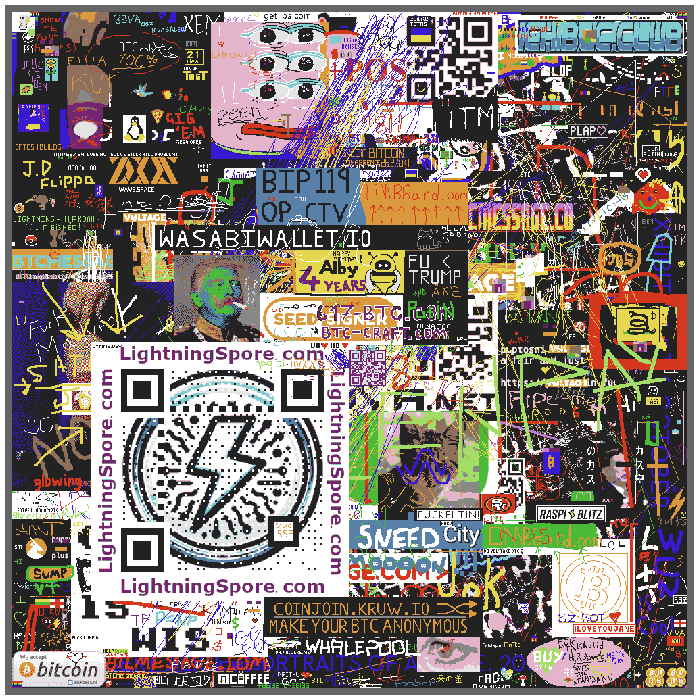
Cover: satoshis.place